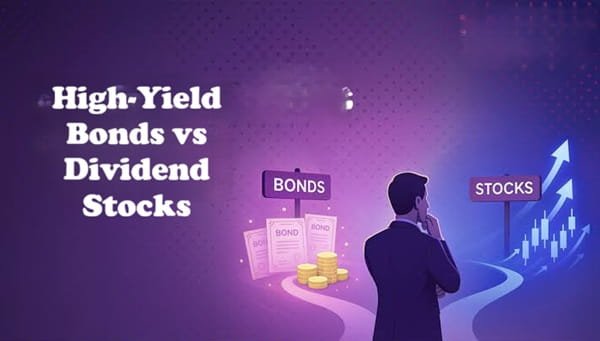
Investors looking for regular income often compare high-yield bonds with dividend-paying stocks. Both can generate cash flow, but they do so in very different ways. High-yield bonds generally offer higher interest payments because investors accept greater credit risk, while dividend stocks can provide income alongside the potential for long-term share-price appreciation.
The question of which investment “pays more” therefore cannot be answered by comparing only the advertised interest rate or dividend yield. Investors should consider total return, risk, taxation, capital appreciation, income stability, and the possibility of losing principal.
What Are High-Yield Bonds?
High-yield bonds are debt securities issued by companies or other entities that carry relatively lower credit ratings than investment-grade bonds.
Because the issuer is considered more likely to experience financial difficulties, investors generally demand a higher interest rate as compensation for taking additional credit risk.
For example, a high-yield corporate bond might offer a significantly higher coupon than a government security or highly rated corporate bond.
However, the higher yield comes with a higher possibility of missed interest payments, restructuring, or default. The investor’s recovery in a default depends on factors such as the issuer’s assets, seniority of the debt, collateral, and restructuring or insolvency process.
What Are Dividend Stocks?
Dividend stocks are shares of companies that distribute part of their profits or available cash to shareholders through dividends.
A dividend is not the same as bond interest. A company generally has greater flexibility over whether and how much dividend it pays, subject to applicable law and corporate decisions.
Companies with established businesses and relatively stable cash flows may choose to distribute regular dividends, but dividend payments are not guaranteed.
A stock investor can potentially earn returns from two sources:
- Dividends received during the holding period
- Capital appreciation if the share price rises
However, the share price can also fall, potentially resulting in a capital loss that is much larger than the income received.
Which Offers the Higher Income?
On the surface, high-yield bonds may appear more attractive to income-focused investors because their interest rates can be higher than the dividend yields of many established companies.
For example, suppose a bond offers an 8% annual yield while a stock has a 4% dividend yield. If both investments cost ₹1 lakh, the bond’s stated annual income would be approximately ₹8,000, compared with ₹4,000 in dividends from the stock, before considering taxes and other factors.
But this does not automatically make the bond the better investment.
The bond’s higher yield may reflect significantly greater credit risk, while the stock’s lower dividend yield may be accompanied by stronger growth and capital appreciation potential.
Total Return Matters More Than Yield
A better comparison is total return.
For a bond, total return can include interest income and any gain or loss caused by changes in the bond’s market price, assuming it is sold before maturity.
For a stock, total return generally consists of dividends plus changes in the share price.
Consider a simplified example:
- High-yield bond: 8% annual income and no price change
- Dividend stock: 4% dividend yield plus 7% share-price appreciation
In this example, the stock could produce an approximate 11% total return, compared with 8% from the bond.
However, the stock’s 7% appreciation is not guaranteed. Its price could instead decline.
This illustrates why income yield alone cannot determine which investment will ultimately pay more.
High-Yield Bonds Have Credit Risk
The biggest risk associated with high-yield bonds is the financial condition of the issuer.
A company offering a high interest rate may have substantial debt, weak cash flows, or exposure to a cyclical industry.
If the company becomes unable to meet its obligations, bondholders may face delayed payments, restructuring, or losses.
Investors should therefore examine credit ratings, financial statements, debt levels, cash flows, interest coverage, maturity, and the bond’s position in the issuer’s capital structure.
A high yield should be viewed as compensation for risk, not as free additional income.
Dividend Stocks Have Market and Business Risk
Dividend stocks carry a different set of risks.
Even a company with a long history of paying dividends can reduce or suspend its dividend if profits or cash flows deteriorate.
The stock price can also decline because of weak earnings, changing interest rates, economic conditions, industry disruption, or broader market sentiment.
Unlike a bond’s contractual interest obligation, dividends are generally discretionary and depend on the company’s financial and corporate circumstances.
Therefore, a high dividend yield should not automatically be interpreted as a safe income stream.
Capital Appreciation Favors Stocks
One area where dividend stocks can have a significant advantage is long-term growth potential.
A successful company can increase its earnings, expand its business, and potentially raise its dividend over time. Investors can benefit from both growing income and share-price appreciation.
High-yield bonds generally have more limited upside because the investor is primarily entitled to contractual interest and repayment of principal under the bond terms.
If a bond’s market price rises because credit conditions improve or interest rates fall, an investor can benefit by selling it, but the long-term upside is generally more constrained than that of an equity investment.
Bonds Can Offer More Predictable Income
High-yield bonds can have an advantage when predictable contractual income is the primary objective.
If the issuer remains financially sound and makes the scheduled payments, the investor generally knows the coupon structure in advance.
Dividend payments can be less predictable because companies can change their dividend policies.
However, predictable coupon payments should not be confused with guaranteed payments. High-yield bonds carry meaningful issuer risk.
Taxation Can Change the Comparison
Taxes can significantly affect the final return.
Interest from bonds and dividends from stocks may receive different tax treatment depending on the investor’s country, tax regime, holding period, security type, and applicable rules.
Capital gains on shares and bonds may also be taxed differently.
Therefore, investors should compare after-tax total returns, rather than relying solely on pre-tax yields.
High-Yield Bonds vs Dividend Stocks
| Factor | High-Yield Bonds | Dividend Stocks |
| Main income | Interest | Dividends |
| Income certainty | Generally more predictable, subject to issuer risk | Less predictable |
| Credit/default risk | Significant | Company-specific, but no fixed debt claim from owning shares |
| Capital appreciation | Limited relative to equity | Potentially substantial |
| Principal volatility | Can fluctuate | Can fluctuate significantly |
| Dividend/interest flexibility | Contractual under bond terms | Dividends can be reduced or suspended |
| Growth potential | Generally limited | Potentially high |
| Suitable for | Investors seeking higher fixed-income yield who accept credit risk | Investors seeking income plus long-term growth |
Which Is Better for Income Investors?
The answer depends on the investor’s objective.
Someone prioritising contractual income may consider high-yield bonds, provided they understand the possibility of issuer default and market-price fluctuations.
An investor seeking long-term wealth creation alongside income may prefer dividend-paying stocks because of their potential for dividend growth and capital appreciation.
Some investors may choose to combine both. A diversified portfolio can include different asset classes so that the investor does not depend entirely on one source of income or one type of risk.
Final Thoughts
High-yield bonds can provide higher and more predictable income, but that income comes with greater credit risk. Dividend stocks generally offer less predictable income but can provide significantly greater long-term growth potential through both dividends and capital appreciation.
So, which pays more? Neither is automatically the winner. A high-yield bond may generate more immediate income, while a successful dividend stock can potentially deliver a higher total return over many years.
The right comparison should consider yield, credit quality, dividend sustainability, capital-growth potential, taxation, investment horizon, liquidity, and risk tolerance. Investors should never choose a high-yield investment solely because its advertised return is higher; the extra yield often exists precisely because the underlying risk is higher.