The wind energy sector in India has become a major pillar of the country’s renewable-energy transition. India ranks fourth globally in installed wind-power capacity and is increasingly strengthening its domestic manufacturing ecosystem. In 2026, the sector is entering a new phase of growth driven by larger turbines, improved transmission infrastructure, competitive bidding, hybrid renewable projects and rising demand for clean electricity.
India’s installed wind capacity reached 58.52 GW by August 31, 2026, according to the Ministry of New and Renewable Energy (MNRE). During April–August 2026, the country added about 2.43 GW of wind capacity. The government is targeting 100 GW of wind capacity by 2030 and 156 GW by 2036, supported by India’s substantial wind resources.
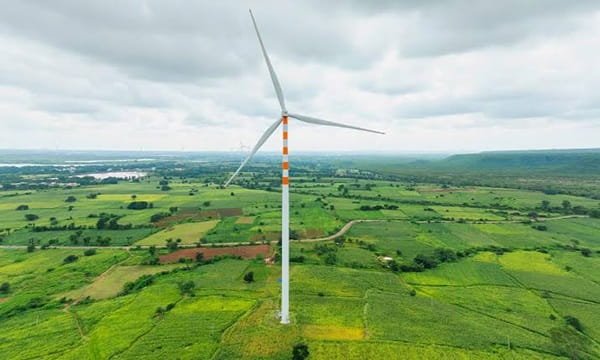
Wind Energy Capacity and Growth in India
India’s wind-power capacity has expanded substantially over the last decade. Installed capacity increased from 21.04 GW in March 2014 to 56.09 GW in March 2026, representing a more than 2.6-fold increase. The country added a record 6.05 GW during FY2025–26, compared with 4.15 GW in FY2024–25.
Wind generation is also becoming more important for India’s electricity system. During FY2025–26, wind projects generated approximately 106 billion units of electricity, compared with 83 billion units in each of the previous two financial years.
One advantage of wind power is that its generation profile can complement solar power. Government data indicates that around 45% of wind generation occurs during peak-demand hours, including periods when electricity demand can remain high after sunset. This makes wind an important component of a renewable-energy system increasingly dependent on solar power.
India’s Wind Energy Potential
India has a large untapped wind resource, particularly at higher turbine hub heights. MNRE estimates India’s gross wind-power potential at approximately 695.5 GW at 120 metres and 1,163.9 GW at 150 metres above ground level.
The largest potential is concentrated in states such as Rajasthan, Gujarat, Maharashtra, Karnataka, Andhra Pradesh, Tamil Nadu, Madhya Pradesh and Telangana. These states have favourable wind conditions and are therefore important locations for future wind projects.
More than 900 wind-monitoring stations have been established across India, while wind-resource maps have been developed at different heights to identify suitable locations for new projects.
Major Wind Energy Companies in India
India has developed a strong ecosystem of wind-turbine manufacturers, project developers and renewable-energy companies.
Suzlon Energy is one of India’s best-known wind-turbine manufacturers and renewable-energy companies. It manufactures turbines, provides project solutions and operates wind-energy assets.
Inox Wind is another major Indian wind-turbine manufacturer involved in equipment production, project development and operations and maintenance services.
Adani New Industries and other companies within the Adani group are expanding their renewable-energy and wind-manufacturing capabilities.
GE Vernova, Siemens Gamesa Renewable Energy and Senvion are important international players with manufacturing or technology operations in India.
Other renewable-energy companies such as ReNew, NTPC Green Energy, Tata Power Renewable Energy, JSW Energy and Greenko are also participating in India’s expanding wind and renewable-energy market.
Government-industry initiatives have encouraged manufacturers to expand production. Several major companies have committed additional manufacturing capacity toward 2030, including Adani New Industries, Suzlon, INOX GFL Group, GE Vernova, Senvion and Siemens Gamesa.
Wind Turbine Manufacturing in India
Domestic manufacturing is becoming a major strength of India’s wind sector. India’s annual wind-turbine manufacturing capacity has increased significantly and was around 24 GW as of March 2026, compared with about 10 GW in 2014. The industry has achieved approximately 70–80% indigenisation across key components.
Indian manufacturers and suppliers produce important components including blades, towers, gearboxes, generators, nacelles and other turbine equipment. MNRE reports that domestic wind-turbine manufacturing capacity is currently around 18 GW per year, with turbine models reaching unit sizes of up to 5.2 MW.
The development of domestic manufacturing is important because it reduces supply-chain risks, creates industrial employment and can position India as an export base for wind equipment.
Government Policies Supporting Wind Energy
Government policy is playing an important role in accelerating wind deployment. India has introduced a dedicated Wind Renewable Purchase Obligation (RPO) trajectory, requiring obligated entities to procure specified amounts of electricity from wind projects.
Competitive bidding guidelines have also helped create a more transparent framework for procuring grid-connected wind power. The government has additionally strengthened the Approved List of Models and Manufacturers (ALMM) framework to support quality and domestic manufacturing.
Offshore wind is another emerging opportunity. The Union Cabinet approved a ₹7,453 crore viability-gap-funding scheme for 1 GW of offshore wind projects, helping address the higher costs associated with developing offshore wind farms.
Onshore and Offshore Wind Opportunities
Most of India’s existing wind capacity is onshore, but offshore wind could become an important long-term growth area.
Offshore projects can access stronger and more consistent wind resources, although they require significantly higher investment in foundations, subsea cables, installation equipment and transmission infrastructure.
Gujarat and Tamil Nadu have particularly strong potential for offshore wind because of their coastal geography and favourable wind resources.
The development of offshore projects could also create opportunities for ports, heavy engineering, marine construction and specialised manufacturing.
Challenges Facing the Wind Energy Sector
Despite strong growth, India’s wind industry faces several challenges.
Land acquisition and transmission availability can delay projects, particularly in areas with high renewable-energy potential but limited grid infrastructure.
Wind power is also variable, meaning electricity generation changes according to weather conditions. Greater deployment therefore requires improved forecasting, flexible power systems and energy storage.
Another challenge is the financial condition of some distribution companies. Delayed payments can affect project developers and reduce investor confidence.
The industry also needs to maintain competitive turbine prices while investing in larger and more efficient machines. Recycling old turbine blades and managing end-of-life equipment will become increasingly important as India’s installed wind fleet ages.
Future of Wind Energy in India
The future of India’s wind sector is expected to be closely linked with solar-wind hybrid projects, energy storage, green hydrogen, offshore wind and larger turbines.
Hybrid projects can combine wind and solar generation to improve the utilisation of transmission infrastructure and provide a more balanced renewable-power profile. Wind can also support green-hydrogen production by providing renewable electricity to electrolysers.
Technological improvements are likely to increase turbine capacity and allow developers to generate more electricity from locations with moderate wind speeds. Digital monitoring, artificial intelligence, predictive maintenance and advanced forecasting can further improve project performance.
With around 28 GW of additional wind capacity under implementation, the sector already has a substantial project pipeline.
Conclusion
The wind energy sector in India in 2026 is moving into a period of accelerated growth. Record annual capacity additions, rising electricity generation, expanding domestic turbine manufacturing and significant untapped wind potential provide a strong foundation for the industry’s next phase.
India’s target of 100 GW of wind capacity by 2030 is ambitious but supported by a large resource base, growing manufacturing capabilities and policy measures.
The biggest opportunities will come from larger turbines, hybrid renewable projects, offshore wind, storage and improved grid infrastructure. If India can address transmission, financing, land and project-execution challenges, wind power can become an even more important part of the country’s clean-energy mix while creating opportunities for domestic manufacturing, exports, investment and employment.